

Massachusetts has the highest electricity rates in the continental US. But some ratepayers pay noticeably less.
By Sabrina Shankman Globe Staff, April 5, 2026

Christine Moreau and Andrew Feland live just 10 miles from each other, but their household utility bills are worlds apart.
Moreau lives in Worcester and gets her electricity from two for-profit companies, a third-party energy supplier and National Grid. Her monthly bills have gotten so large, $400 one month, $600 the next, that she’s being threatened with shut-off notices.
Feland lives in West Boylston, which is serviced by a nonprofit, the town-owned municipal light plant. And despite using almost double the amount of electricity as Moreau because his house now has heat pumps, his last monthly bill was less than hers by about $100.
“It just doesn’t make any sense, how one area can be that low and then another area can be this high,” said Moreau, whose rate with her electric supplier is similar to what National Grid offers elsewhere in Worcester. “It feels like you’re getting screwed.”
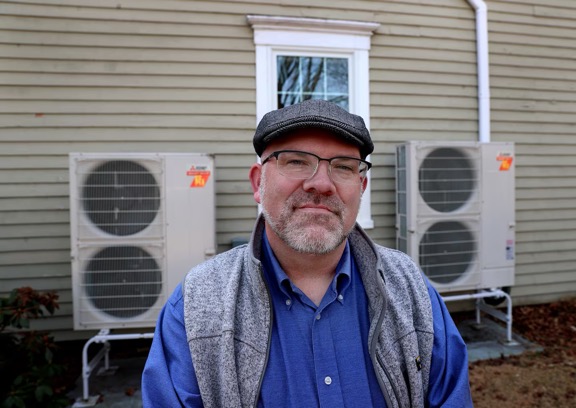
Andrew Feland, near the heat pumps at his home in West Boylston.David L. Ryan/Globe Staff
West Boylston and several dozen other communities with municipal utilities are like oases in a state with the highest electricity rates in the continental US, according to the US Energy Information Administration. They typically charge half of what the big utilities do, while often offering greener energy, too.
There are multiple reasons for such a huge disparity in costs between publicly traded utilities and municipal light plants — so named because many were started a century or more ago to bring street lights to their communities. For one, municipal utilities are a fraction of the size of the for-profit companies, and it’s just easier and less expensive to maintain the heavy infrastructure over such a small territory.
Secondly, many Massachusetts municipal utilities continue to benefit from ownership arrangements with the Seabrook and Millstone nuclear power plants, which locked them into long-term supply contracts at roughly 5 cents per kilowatt hour — bargain prices by today’s standards. Ironically the Seabrook plant was highly controversial at its outset because of concerns over the safety of nuclear power. Now, however, Governor Maura Healey has made developing new nuclear sources among the solutions to the current cost crisis.
But perhaps no one factor is more influential than the obvious one: Municipal utilities don’t have shareholders pressuring them for ever-higher profits and dividends. Instead, municipal light companies have the luxury of investing surplus funds back into the business to become more efficient.
“Their profits go right back into the light plant,” said John Odell, chief sustainability officer in Worcester. “They go in to make the system more efficient, more effective, more reliable.”
That question of profits is particularly salient right now as many customers of for-profit utilities complain their ever-increasing electric bills have become unaffordable. Energy bills are the biggest worry that Massachusetts residents have about their household expenses, according to a recent poll.
Nationally, utilities have been making roughly 13 cents on every dollar that customers pay, according to a recent report from the Energy and Policy Institute, a watchdog organization.
Eversource’s profits were higher than the national average — nearly 16 cents on the dollar — meaning that of a $500 bill, not quite $80 went to the company in profit, based on calculations provided by the Energy and Policy Institute.
Doug Horton, senior vice president of regulatory and strategic financial planning for Eversource, said he understood how such profit margins are both “a sexy headline” and a valid concern for ratepayers. But he said those margins are far from the only driver of rising bills, citing increased supply costs and expensive public programs.
Publicly traded utilities don’t get to decide how much to charge and profit on their own. They are highly regulated by state government and each year go through a lengthy review of their costs and investments, with regulators setting the ultimate profit ratios for them.
Ari Peskoe, director of the Electricity Law Initiative at the Harvard Law School Environmental and Energy Law Program, said the main source of profits for utilities is through capital spending on infrastructure, such as new transformers and substations. That model ensures utilities keep their systems modern and less vulnerable to interruptions, but critics say that without a more rigorous regulatory review it can lead to excessive development on the ratepayer’s dime.
National Grid spokesperson Bob Kievra defended the company’s pricing as a “transparent public process,” adding that “investment decisions are subject to regulatory review.”
There is another contributing factor that is beyond the control of for-profit utilities: Unlike municipal light plants, they have to charge customers a whole bunch of fees to fund energy efficiency programs and other priorities of the state government.
The main one of those is Mass Save, which uses the fees utilities collect to fund electric heat pumps, home insulation and weatherization, and other initiatives to lower consumption and wean the state off of fossil fuels.
“The fact is that as state-regulated, investor-owned utilities, we are required under legislation and our regulator to administer certain programs that the municipalities just aren’t,” said Horton.
To be sure, there can be downsides to receiving power from a municipal light plant — namely customers don’t qualify for the Mass Save program and the energy retrofits that come with that. But, the smaller players often offer their own incentive programs. Last year the West Boylston light plant conducted 150 free energy audits and 34 heat pump consultations and rebates and offered various incentives for ENERGY STAR appliances and Wi-Fi thermostats.
Moreover, some municipal utilities have been able to offer customers better options on green energy. The energy mix of electricity in West Boylston, for example, is 60 percent clean — a mix of wind, hydro-electric, solar, and nuclear. And by 2030, the town is on track to hit 80 percent, according to Jonathan Fitch, general manager of the West Boylston Municipal Lighting Plant. That includes solar fields and battery storage the town built and owns.
By contract, investor-owned utilities last year delivered a little more than half of its electricity, 51 percent, from natural gas, with an additional 1 percent from oil. The remainder is a mix of primarily nuclear, hydro, solar, and wind.
To meet state requirements for clean electricity, investor-owned utilities also purchase “renewable energy credits,” for example investing in a solar farm in another part of the Northeast. Those costs are passed to ratepayers as part of the supply portion of their bill.
Right now municipal utilities provide electricity to residents of 52 communities, about 13 percent of all ratepayers in Massachusetts. And understandably, given the concerns over electric bills, the municipal industry is happy to woo potential converts.
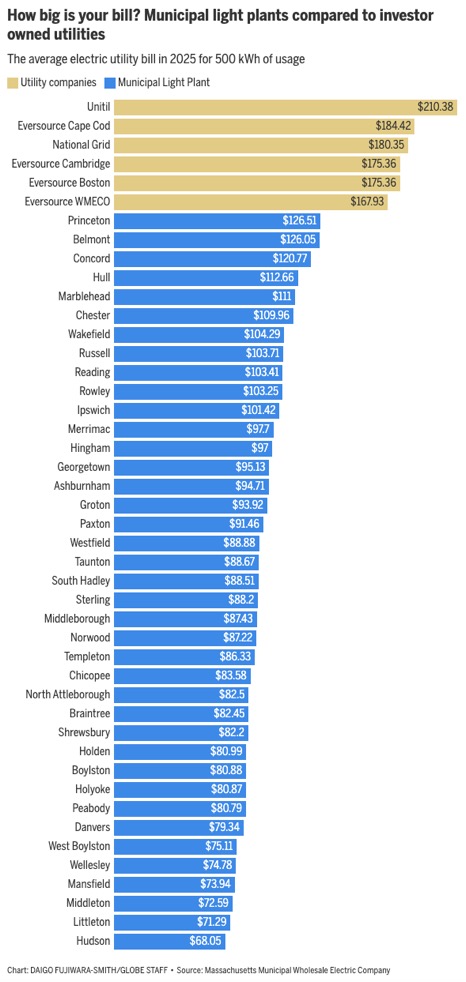
“I think there’s many people out here who would benefit from this [light plant] model,” said Tom Barry, chief executive of the Massachusetts Municipal Wholesale Electric Company, a not-for-profit, state-designated agency that provides services to the municipal utilities. He’d like to see more communities adopt the small-scale utility, not-for-profit model.
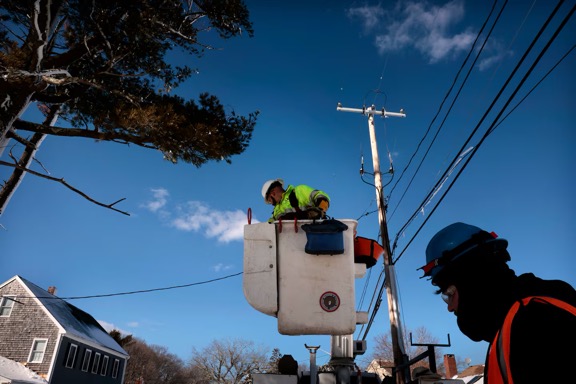
Eversource linemen Justin Sessa and Omer Celik (right) worked on power lines on Winslow Street in Marshfield after a blizzard on Feb. 24.Craig F. Walker/Globe Staff
Who wouldn’t like to pay less for electricity? But as Peskoe, head of the Electricity Law Initiative at Harvard, put it succinctly: “Good luck.”
In order to move from an investor-owned utility to a municipal model, a community would first have to rally voters to approve the change — which may not be such a straightforward vote once they find out how much it would cost. Since it’s likely not practical to build an entire system from the ground up, a community would instead have to buy all the existing infrastructure — the poles, wires, transformers, etc. — from the utility whose business they no longer want.
Costs would run well into the millions of dollars, and in larger communities, in the billions.
“The utility is either going to demand an incredibly high price or oppose this effort, and that’s just going to lead to litigation,” Peskoe said.
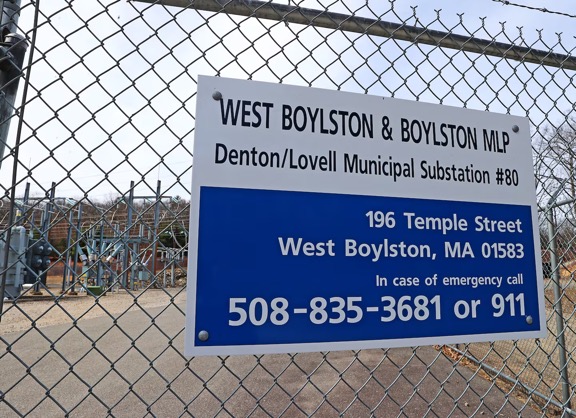
Electric bills for people living in West Boylston can be less than half of what ratepayers in communities with investor-owned utilities pay.David L. Ryan/Globe Staff
There is another approach that is less involved but has far less potential for savings than going fully community-owned: so-called municipal aggregation programs, in which a community joins together to purchase just the electric supply portion of the service, leaving the utilities in place to deliver that power to customers. The state has approved aggregations for 225 communities. In Boston, residents on the city program save an average of $200 a year.
In Worcester, Moreau said she’s going to look into switching over to the city’s municipal aggregation program. On her most recent bill, it would likely save her about $30.
Meanwhile Odell, who manages that aggregation program for Worcester, admits to being tempted by the municipally owned utility model.
“Of course we’ve looked at doing that,” he said. “But it’s a real big lift.”
Clarification: Massachusetts has the highest energy rates in the continental US and among the highest bills.
Sabrina Shankman can be reached at sabrina.shankman@globe.com.